KG LEGAL Kiełtyka Gładkowski
We provide asset tracing in Poland for international creditors, their advisers and overseas trustees. We identify debtors’ assets and develop strategies for pursuing claims. Our work combines legal expertise, Polish private investigation qualifications and the analysis of financial, corporate and blockchain data.
We investigate situations where a debtor fails to pay, moves business operations to another entity or disposes of assets. Asset tracing connects information about companies, property, transfers and online content with a specific creditor’s case. We assess each finding for its evidential value, its relevance to interim relief and the pursuit of the claim.
Our work also covers cryptocurrencies, Ponzi schemes and the enforcement of foreign court judgments and arbitral awards. We assist overseas trustees with assets and claims connected with Poland.
Discuss asset tracing for your matter. Contact KG LEGAL with details of the claim, known connections with Poland and the steps taken so far.
Investigation qualifications · Asset tracing scope · OSINT · OPSEC · Blockchain asset tracing · Foreign judgments · Overseas trustees · Legal framework · Asset tracing glossary · FAQ · Contact · Sources
We hold private investigation qualifications in Poland. Activities requiring a private investigator’s licence are carried out by a person holding a Polish private investigator’s licence issued by the competent Provincial Police Commander. We combine these capabilities with legal representation of the creditor, knowledge of Polish procedures and the assessment of evidence.
The Polish Act on Detective Services of 6 July 2001 expressly covers commercial matters concerning the performance of financial obligations, ability to pay and commercial reliability, as well as the search for property. These areas are directly relevant to asset tracing. The principal provisions are Article 2(1)(2)(a) and Article 2(1)(5), while Article 35(1) governs the issue of licences. [1, 2]
Within the scope of an instruction, we obtain and verify information, analyse relationships between entities and document circumstances relevant to the debtor’s financial position. We combine information from different sources, compare its dates and content, and identify inconsistencies requiring further investigation. Information from individuals, businesses, institutions and public authorities is obtained subject to Article 9 of the Act and the restrictions imposed by other legislation. [1]
Technology supports the analysis, organisation and documentation of our findings. The law determines the scope of our activities: Article 7 of the Act excludes the use of technical measures and operational intelligence methods and activities reserved for authorised public bodies. Our work places particular importance on the lawfulness of the source, reliable verification and the potential use of the findings in the specific case. [1]
We process information obtained in the course of private investigation services within the statutory scope of those services. Article 28a permits the processing of collected data without the data subject’s consent solely for the purpose of providing the service. Other data protection obligations and specific confidentiality regimes must be considered separately. We document the results of our work in a report, together with the materials supporting our findings. [1, 3]
Asset tracing is the targeted investigation of assets, their current location, the history of transfers and their connections with particular individuals or entities. It can examine both assets still held by the debtor and transactions through which value has passed to other entities.
In practice, we combine the search for assets with legal assessment. Establishing that a company uses a property does not establish that it owns it. A shareholder’s connection with another company requires an assessment of whether there is a basis for a claim against that company. A cryptocurrency trail may identify a receiving address or service provider, but identifying the person involved and establishing whether the funds can be attached require further work.
The result is an organised basis for decision-making: which assets and relationships have been identified, how strong the evidence is, what remains missing, what steps can be taken, and the costs, timescales and risks of each available route. Asset recovery then encompasses the steps intended to recover value in practice, including interim relief, litigation, settlement and enforcement.
Our practice serves international businesses and creditors whose counterparty, assets or material connections are in Poland. We also work with overseas law firms handling cross-border disputes, and with trustees and other office-holders dealing with assets or claims that require action in Poland.
We assist in particular where:
Asset tracing examines both individual assets and the relationships that help establish their location and relevance to a creditor.
We tailor the scope of the investigation to the claim and the available information. It may cover real estate, shares and other corporate rights, trade receivables, rights to payment under contracts, movable property and business equipment, intellectual property rights, disclosed bank accounts and digital assets.
We also examine ownership structures and actual control over entities, changes in management, beneficial ownership, and transfers of a business or its assets. We identify the individuals and companies connected with the movement of value under investigation. We distinguish ownership of a particular asset, control over a company and the legal basis for liability for a debt: each requires its own supporting grounds.
When assessing the usefulness of an asset, we consider existing encumbrances, the priority of other creditors, marketability and the anticipated costs of proceedings. What matters to the creditor is the value that can be realised through the relevant procedure.
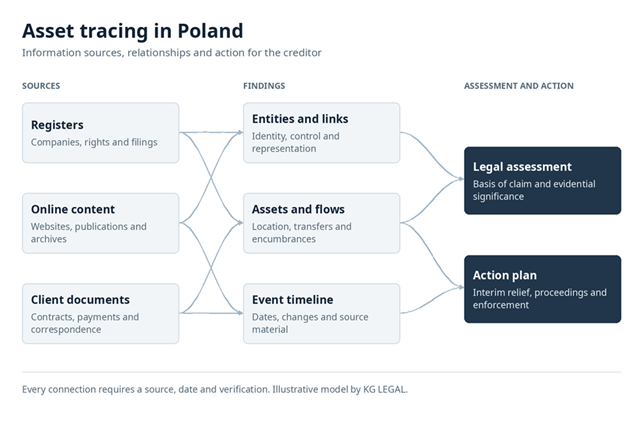
A model for relationship analysis. Each link requires a source, date and legal assessment. Illustrative diagram by KG LEGAL.
We analyse current and historical information in the Polish National Court Register (KRS), together with available registration documents. We compare changes in authorised representatives, conversions, mergers, divisions, disclosed ownership links and successive stages of business activity. For sole traders, we use the relevant information in the Central Registration and Information on Business (CEIDG). [11, 13]
We present connections through an entity map and a chronology of events. Comparing names, addresses, authorised representatives, internet domains and the history of business operations helps identify relationships requiring closer examination. We assess each element in the context of the remaining evidence.
We use information from the Central Register of Beneficial Owners (CRBR) to analyse declared control over entities. We test it against corporate documents, the history of changes and other available information. The identification of a beneficial owner is a starting point for analysing the structure; it does not, by itself, establish that person’s liability for the company’s debts. [14]
We compare financial statements and accompanying notes available through the Financial Documents Repository (RDF). We examine changes in assets, receivables, liabilities, equity and related-party transactions. We also check information disclosed in the National Register of Debtors (KRZ). Public documents help establish lines of enquiry; a full analysis of a particular transaction may require additional materials obtained from the client or through the appropriate proceedings. [12, 15]
In asset tracing, we investigate business continuity and the actual movement of value between entities.
A debtor may reduce its visible activity while a new entity carries on a similar business. In such matters, we reconstruct the chronology of changes and examine what was actually transferred: assets, contracts, receivables, brand rights, domains, equipment or an organised part of the business.
We compare the dates on which the debt arose, demands for payment were made, proceedings began and the business structure changed. We analyse the commercial rationale for transactions, their documentation and settlement, to the extent supported by the available material. We investigate whether the consideration for disposed assets was actually received by the debtor and whether it remains available to creditors.
When examining financial documents, we focus on transactions requiring explanation: intra-group loans, assignments of receivables, service charges, payments to connected entities, changes in asset values, transfers of profitable contracts and revenue recorded in another entity. Our assessment is based on documents, arrangements and the actual course of events. An unusual accounting entry is a reason for further investigation, rather than a conclusion that misconduct has occurred.
Where the material indicates prejudice to a creditor, we assess the availability of an actio pauliana, or creditor challenge to prejudicial transfers, other claims against the recipient of assets, liability of the purchaser of a business or liability of particular individuals. The appropriate action depends on the requirements of the relevant legal basis. In the case of the management board of a Polish limited liability company, this may include examining Article 299 of the Commercial Companies Code. [8, 9]
We identify information that enables property connected with the matter to be located and verify its registered legal status. We examine land and mortgage registers, ownership rights, mortgages, claims and other entries relevant to interim relief or enforcement. Public access to an electronic land and mortgage register requires its register number. Information from the land and buildings register is obtained in accordance with the applicable access conditions, including the need for an appropriate legal basis for certain information. [16, 17]
We also examine registered pledges and other disclosed security interests. This enables us to assess whether an identified asset has practical significance for the particular debt, whether it is subject to other parties’ rights and what steps should precede enforcement against it. [18]
Asset tracing connects factual findings with the available legal route to financial information.
Bank accounts, financial flows, tax affairs and information held by service providers may be material to asset investigations. For each category, we identify the source, the legal basis for access and the appropriate procedure for obtaining the data.
We use documents held by the client, information disclosed in registers and accounts published in the list of VAT taxpayers. That list does not disclose balances or transaction histories. Further banking information is subject to banking secrecy and may be obtained in the circumstances specified in the Polish Banking Law. In particular, the legislation gives a court enforcement officer (bailiff) powers in the relevant proceedings, to the extent necessary to perform their duties. [5, 19]
As legal representatives, we prepare applications and identify the information needed for the case. In enforcement proceedings, we use the statutory mechanisms for identifying assets, asset searches by the court enforcement officer and disclosure of assets. In court proceedings, we assess the appropriate applications for evidence and the need to preserve evidence. [4]
Information in tax returns and tax files is protected by tax secrecy. Traffic data, communications information and certain data about service users are subject to separate restrictions. Where such information is required, we identify the appropriate procedure and action by the authorised body. Neither private investigation qualifications nor a litigation power of attorney creates unrestricted access to these resources. [1, 6, 7]
OSINT, or open source intelligence, helps establish facts about a debtor’s activities, connections and the movement of particular assets. In asset tracing at KG LEGAL, we connect material available online with the client’s documents, register information and legal assessment. The investigation addresses specific questions: who conducts the business, under which brand, through which entity and from what date.
The content, provenance and context of information matter. A company website, advertisement, PDF document or public profile may identify a direction for further enquiries. We assess each material conclusion separately, considering the source’s currency, the possibility of error and the need for confirmation from other material.
At the outset, we establish the research objective, known identifiers and the period relevant to the claim. This focuses the analysis on facts capable of informing the creditor’s decision. Connecting a document to the correct entity and event is more useful to the matter than a large collection of unstructured search results.
We examine material relevant to the matter: business websites, terms and conditions, seller information, product catalogues, advertisements, announcements, corporate documents and publicly available professional content. We look for information about continued business activity, changes of operator, use of a brand, contact details and relationships between individuals and entities.
An illustrative research question concerns a debtor that stops presenting its offering while a similar offering appears under a new name. We compare the business activities, publication dates, identifying information and available documents. We then determine which elements require confirmation through registers, contracts or material obtained in the appropriate proceedings.
We organise variations in names, registration numbers, addresses, domains and trading names. Reconciling these records, known as entity resolution, reduces the risk of attributing information to the wrong individual or company. A matching surname, shared address or similar trading name provides a point for verification.
For each material connection, we identify its nature: ownership, representation, an asserted business relationship, shared contact details or simply similar information. A shared hosting provider or IP address may reflect unrelated entities using the same infrastructure. We distinguish confirmed findings from hypotheses and information that could not be verified. The resulting relationship map helps identify further questions and the evidence required.
We compare current content with available archived versions. We examine changes in names, operator details, offerings, terms of sale and stated relationships. We compare them with the date the obligation arose, demands for payment and corporate events.
A web archive’s capture date is different information from a page’s original publication date. We check the date of the particular resource and the completeness of the preserved copy. An archive may omit images, attachments or dynamic elements, and links may lead to material from a different date. We reflect these limitations in our findings. [51]
The analysis may be supported by Maltego, a tool for representing information as entities and relationships on a graph. Functions called Transforms allow particular sources to be queried and connections between collected data to be explored. The available scope depends on the chosen integrations, sources and conditions of use.
The graph helps organise the material and identify directions for further analysis. We assess individual connections by reference to their source, date and legal significance. A visual relationship map helps explain the matter; a conclusion about asset ownership or liability for a debt requires an appropriate evidential basis. [49, 50]
We record the source address, collection time, publication context and preservation method. Depending on the type of data, we retain the source file, a page copy, a screenshot and a record of the steps taken. We separate material retained for preservation from working copies.
Cryptographic hash values, such as SHA-256, support checks that files remain unchanged. Records of transfer, access and analysis help establish the handling history known as the chain of custody. A matching hash does not establish that the content of a publication is true. The firm also assesses its relevance to the claim and the appropriate way to present it in the proceedings. [52]
OPSEC, or operational security for the research process, includes protecting information about the client, the instruction and the activities undertaken. In asset matters, premature disclosure of an interest in particular assets may hinder further enquiries. We therefore plan the sequence of activities and limit the disclosure of information that could unnecessarily identify the client or analyst.
We assess the traces that may be left by contacting a website, querying a data provider, using an account or downloading a document. We select measures according to the risks and objectives of the matter. We combine discretion with internal accountability by retaining information that allows the source of a finding and activities within the agreed scope to be reconstructed.
We use dedicated analytical environments, including Linux environments, adapted to the task. We separate research profiles from everyday work involving client correspondence and documents. Access arrangements, updates, file protection and rules for handling downloaded material help reduce information disclosure and risks to the matter.
We also control the information supplied to external tools. A client’s name, a full description of the matter or a confidential document should not be submitted to a service solely because it makes searching easier. Before using an integration, we examine its function, data source and query handling. Some Maltego mechanisms use servers operated by the vendor or a partner, which we consider when selecting a solution. [49]
For appropriately selected tasks, we use Tor Browser and measures to protect connection privacy. Tor Browser is a browser that uses the Tor network; the choice of search engine is a separate matter. Simply opening the browser does not route other applications’ traffic through Tor.
We assess protection across the task as a whole. Logging in, submitting information through forms, application characteristics or a document opened outside the browser may disclose information. OPSEC aims to reduce identification risks and unintended disclosure of an interest in the matter. No single tool provides complete invisibility. [47, 48]
We present OSINT results as findings, relationships, a chronology, a source index and recommended next steps. We also identify information gaps and matters requiring an official document, service provider data or other material. This connects online research with asset tracing, assessment of the claim and preparation of legal action in Poland.
We tailor our precautions to the nature of each activity. When providing detective services, we also observe the statutory duties of the licence holder, including Articles 10 and 11 of the Polish Act on Detective Services. [1]
We analyse cryptoasset flows to establish the path of transfers, connections with service providers and further evidential and legal options. We combine on-chain data, meaning records available on the relevant blockchain, with off-chain material: the client’s documents, payment confirmations, correspondence, registry data and information lawfully obtained from service providers.
In matters requiring specialist cryptocurrency analysis, we work with former law enforcement officers experienced in international police cooperation, including cooperation with Interpol. Their expertise supports the technical analysis, while the firm integrates the findings into the legal strategy for identifying entities, preserving evidence and pursuing claims.
We begin by verifying the network, asset type, addresses, transaction identifiers and materials establishing the transfer’s connection with the case. We organise amounts, dates, token identifiers and contract addresses. The same token symbol may appear on different networks, so the asset under investigation must be correctly identified.
For Bitcoin, the analysis takes account of transaction inputs and outputs and the unspent transaction output model, known as UTXO. In account-based networks such as Ethereum, token transfers and interactions with smart contracts are also relevant. We agree the scope of the investigation into particular networks and instruments according to the needs of the case and the available technical capabilities. [20, 21]
We reconstruct successive transfers visible in the data and build a graph of relationships between addresses, transactions and recognised services. The investigation may reveal split transfers, consolidation of funds, recurring intermediary addresses and movements into service providers’ infrastructure. A chronology allows these operations to be compared with payments by victims, correspondence and the activities of entities involved in the case.
Address clustering requires consideration of the particular method used and its limitations. A transaction between addresses does not necessarily indicate common control. Certain transaction structures, including transactions jointly created by multiple users, may undermine simple heuristics. We assess wallet attribution, meaning the attribution of an address to a person or business, by reference to the quality and provenance of the evidence. [22, 23]
Where the material indicates an exchange of assets or a transfer between blockchains, we examine the role of exchanges, conversion services, decentralised protocols and blockchain bridges. Cross-chain tracing requires linking the operations on both sides of the transfer and assessing whether that link is sufficiently documented. Public data may not allow every stage to be reconstructed. [24]
Establishing that a transfer reached an address associated with an exchange may identify the next line of enquiry. It does not, however, establish the identity of the exchange’s customer or the location of the funds following the provider’s internal transactions. We assess the need to preserve information and the appropriate route for obtaining identification data, account records or other information subject to the provider’s procedures and the law of the relevant jurisdiction. [22]
Our report distinguishes the transaction record, the result of the technical analysis and a conclusion concerning a particular entity. We identify the sources used, transaction identifiers, the network, relevant addresses, the chronology, assumptions and gaps requiring further evidence. This structure facilitates the use of findings in correspondence with a service provider, procedural applications and cooperation with overseas lawyers.
The ability to trace a transfer depends, among other things, on the nature of the network, the quality of the data, the services used and the availability of off-chain information. Analysis does not itself provide control over a wallet or private key. The possibility of securing or recovering assets requires a separate legal and factual assessment. [20, 22]
Asset tracing helps map the entities, payments and purported investments involved in these matters.
In matters involving Ponzi schemes and suspected fraudulent investment platforms, the key questions are which entity received the funds, who was involved in transferring them and what assets or claims may remain available. We analyse investment materials, payment identifiers, company information, communications history and digital traces associated with the platform’s activities.
We have obtained identifying information about an entity in a matter connected with a Ponzi scheme. We combine the analysis of information about participants in the venture with asset searches and the assessment of appropriate action in Poland. In matters involving multiple creditors and in insolvency proceedings, we also take account of the need to organise creditors’ claims and coordinate with the overseas office-holder.
Further action is based on specific material concerning the role of the relevant entity. We distinguish the operator of the venture, the recipient of a transfer, the infrastructure provider and the payment intermediary. Each role may involve different routes to obtaining information and a different scope of liability.
In these matters, we combine asset tracing with the preservation of digital evidence and an assessment of liability for the loss.
Compromised business correspondence, substituted payment details, impersonation of a counterparty or a fraudulent investment platform can result in a loss of funds. In such matters, we combine the analysis of digital evidence and financial flows with an assessment of the liability of the entities involved and the potential to secure assets.
We develop a strategy for dealing with banks, payment service providers, platforms and other relevant service providers. This includes identifying the information required, making demands and applications within the permitted scope, submitting complaints, reporting suspected offences, representing victims and pursuing claims. We select the appropriate instruments according to the circumstances, jurisdiction and the client’s status.
Cybersecurity matters may also involve personal data protection, the confidentiality of commercial information, regulatory obligations and liability for loss. Our legal analysis therefore considers the GDPR, the national cybersecurity framework and NIS2, DORA, the DSA, MiCA, and the rules on cryptoasset transfers and electronic evidence, according to their actual scope of application. [34–44]
Poland has no single authority supervising every aspect of the internet. For each matter, we identify the competent data protection authority, financial supervisor, digital services regulator or law enforcement body. Incident reporting and supervisory proceedings may support the protection of the client’s interests, but debt recovery requires an appropriate basis for the claim and procedure. The firm’s role is to bring these routes together into a coherent strategy.
For asset tracing, the relevant questions include a participant’s duties and the information that may support a claim.
Where a data breach occurs, we assess its nature, the risk to individuals and the controller’s obligations. This also applies to special categories of data, including health data. Loss of availability or integrity may have legal significance alongside disclosure. We assess the duties to notify the President of the Polish Data Protection Authority (UODO), inform affected individuals and document the event, with reference to Article 9 and Articles 32–34 of the GDPR. [34, 46]
In an asset-related matter, data protection forms part of the proper handling of evidence. The scope of the information processed should correspond to the purpose of the case. Obtaining personal data, disclosing trade secrets and using electronic material require an assessment of the appropriate legal basis.
NIS2 and Poland’s national cybersecurity legislation impose obligations on entities within their scope. The Polish amendment to the National Cybersecurity System Act (KSC) of 23 January 2026 entered into force on 3 April 2026, although transitional provisions are relevant to individual obligations. Following an incident, we establish the entity’s status, the competent authorities and response teams, and the documentation and reporting requirements. [35, 36]
In matters involving financial loss or misconduct, we assess the significance of incident documentation for claims, contractual liability and the preservation of evidence. We combine that assessment with findings on the movement of value and the actions of the individuals and entities involved.
DORA, applicable since 17 January 2025, addresses the digital operational resilience of specified financial sector entities. Its relevance depends on the status of the parties involved. We analyse the applicable obligations concerning ICT risk, incident documentation and reporting, and relationships with technology providers. We assess which information and obligations are relevant to protecting the client and to potential claims. [37]
We verify the status of the cryptoasset service provider, its authorisation and the relevant supervisory jurisdiction. MiCA sets requirements for entities and services within its scope; the specific course of action must reflect the provider’s actual status. Entry in the register of virtual currency activities is not, by itself, a MiCA authorisation. [38, 39]
Regulation 2023/1113, applicable since 30 December 2024, imposes obligations concerning information on the originator and beneficiary of a transfer. The Travel Rule helps establish what information a provider within its scope may hold. That information does not have to be visible on the public blockchain. Obtaining it for a case requires an appropriate legal basis and procedure. [40]
In matters involving fraudulent content or services, we assess the available reporting mechanisms for providers and action under the Digital Services Act. Since 6 November 2026, the President of the Office of Electronic Communications (UKE) has performed the duties of Poland’s Digital Services Coordinator. Competence in individual matters is allocated among the relevant domestic authorities, authorities in other countries and the European Commission. [41, 42]
We identify the appropriate recipient of a complaint, the material required and how the report relates to other proceedings. Reporting fraudulent content, obtaining information about its author and recovering transferred funds are distinct legal objectives requiring coordination.
Regulation 2023/1543 has applied since 18 August 2026 and introduces European Production Orders and European Preservation Orders for electronic evidence within its scope. These instruments serve criminal proceedings and require action or validation by an authorised body. The firm can prepare supporting material and applications and represent the victim’s interests. [43]
We assess the type of data, the category of service provider and the permitted route for obtaining it. A preservation order protects evidence against alteration or deletion; securing assets requires a separate instrument. The e-evidence regime is neither a general procedure for obtaining banking information nor a standalone mechanism for pursuing a civil debt. [43]
In payment disputes, we examine the authorisation mechanism, the handling of the payment instruction, the documentation and the contract with the provider. We distinguish an unauthorised transaction, an authorised payment induced by fraud and an incorrectly executed payment instruction. For a business, contractual arrangements permitted by law to depart from certain consumer protection rules are also relevant. Assessing these issues allows us to establish against whom a claim should be brought and on what basis. [44]
| Institution | Role in the matter | Legal action by the firm |
| President of the Polish Data Protection Authority (UODO) | Supervision of personal data protection | Assessment of the breach and notification obligations, and representation |
| Polish Financial Supervision Authority (KNF) or the competent overseas supervisory authority | Statutory supervision of the relevant entity or service | Verification of competence and the provider’s status, and preparation of submissions |
| President of the Office of Electronic Communications (UKE) and the competent DSA authorities | Electronic communications and the relevant powers concerning digital services | Complaints and representation in matters within the authority’s competence |
| CERT Polska and the competent CSIRT | Incident handling and coordination of the response | Preparation of the notification and coordination of supporting material with specialists’ work |
| Police and prosecution authorities | Proceedings concerning a suspected offence | Representation of the victim, and applications concerning evidence and assets |
| Court and court enforcement officer | Determination of the dispute and implementation of protective measures or enforcement | The appropriate claim and applications, and action directed at identified assets |
The choice of route also takes account of jurisdiction and the powers of overseas institutions. Supervisory proceedings, incident response, criminal prosecution and enforcement perform different functions; their coordination should serve the client’s specific objective. [4, 10, 34, 37, 39, 42, 45, 46]
We represent creditors who hold a foreign judgment and wish to pursue assets in Poland. We identify the applicable legal regime, assemble the required documents, conduct the necessary proceedings and prepare for enforcement. We combine the procedural assessment with the identification of assets against which the judgment may be enforced.
In matters covered by the Brussels I Recast Regulation, an enforceable judgment from another EU Member State may be enforced in Poland without a separate declaration of enforceability. The documents and steps required by that regime are nevertheless necessary. For other judgments, we examine the applicable international convention or the provisions of the Polish Code of Civil Procedure. [4, 25]
In UK matters, relevant factors include the date proceedings were commenced, the nature of the case, any exclusive choice of court agreement and the scope of the applicable convention. We examine the post-Brexit transitional provisions, the 2005 Hague Convention, the 2019 Hague Convention and domestic law. The 2019 Convention entered into force for the United Kingdom on 1 July 2025; its application also depends on when proceedings were commenced and whether they fall within its scope. [26–29]
We handle proceedings for the recognition and declaration of enforceability of foreign arbitral awards in Poland. We analyse the 1958 New York Convention, the relevant provisions of the Polish Code of Civil Procedure, the arbitration documents and possible objections by the debtor. Asset findings support the planning of interim relief and subsequent enforcement. [4, 30]
We represent overseas trustees in matters concerning assets and debt recovery in Poland, including trustees from the United Kingdom. We assist in identifying assets, debtors, corporate connections and documents relevant to the performance of their appointed role.
At the outset, we verify the client’s status and authority, and the nature of the claim. A trustee in bankruptcy, an administrator, a liquidator and a trustee of a private trust may act on different legal bases. The appropriate procedure in Poland depends on these distinctions, the terms of foreign orders and the applicable law.
Where a matter concerns foreign insolvency proceedings, we examine the rules on recognition and their effects in Poland. In matters covered by EU Regulation 2015/848, the mechanisms for recognition and the exercise of the insolvency practitioner’s powers in another state are relevant. In other situations, we examine the provisions of the Polish Bankruptcy Law concerning foreign proceedings, including the potential for protective measures over assets and evidence. For UK proceedings, we take account of the separate post-Brexit transitional rules. [29, 31, 32]
We combine the identification of an asset’s location with an assessment of who may bring a claim, against which entity and on what basis. This allows action to be planned from the perspective of the particular office-holder and the interests of the creditors represented.
We use asset tracing findings to assess the steps that may protect assets available to the creditor.
An asset investigation may justify an urgent application for interim relief. We assess the claim, the legal interest in obtaining relief, the risk of further transfers and the available protective measures. Depending on the legal basis and circumstances, these may concern a bank account, receivables, shares, movable property or real estate. The competent authority decides whether to impose a particular measure. [4]
In matters meeting the relevant requirements, we also assess the availability of a European Account Preservation Order. Regulation 655/2014 includes a specific mechanism for obtaining bank account information within that procedure. Using this instrument requires an examination of its scope and the conditions applicable to the particular application. [33]
Where assets have been transferred, we examine the grounds for challenging the transaction or pursuing a claim against a particular person. An actio pauliana may provide creditor protection in relation to a specific transfer where the required conditions are established. In insolvency matters, we consider the relevant avoidance mechanisms and recovery of assets for the insolvency estate. [8, 32]
At every stage, we compare the anticipated outcome with the costs and risks. The findings may support a claim, an application for interim relief, enforcement, action in insolvency proceedings or negotiations. They may also establish the need for further evidence before a more costly stage is undertaken.
We analyse the basis of the debt, the known information about the debtor, the connections with Poland and the steps already taken. We establish whether the priority is to assess recovery prospects, identify a particular asset, prepare an application for interim relief or enforce an existing judgment. We define the scope, priorities and reporting arrangements.
We organise the documents and data received from the client. For electronic material, we consider its provenance, the date of acquisition, metadata and preservation of the original. Where the circumstances require it, we determine how a specialist should be involved and how the integrity of copies should be documented. The aim is to preserve the material’s informational value and enable it to be verified later.
We combine registers, documentation, lawfully obtained information and open-source intelligence, known as OSINT. We reconstruct the chronology of changes and flows. For each material finding, we identify its source and relevance to the case. The cryptoasset element may involve a separate scope of specialist analysis.
We establish which information is confirmed, which remains a hypothesis and what data is needed for further assessment. We then identify potential claims, the competent court, the procedure for obtaining additional information and available protective measures. Where the matter involves several countries, we coordinate the Polish stage with overseas legal representatives or the relevant office-holder.
We prepare a report and recommended action. Within the agreed scope, we represent the client in court proceedings, matters concerning foreign judgments, proceedings for interim relief and enforcement proceedings. We update the analysis when new documents or events are relevant to the chosen strategy.
The asset tracing deliverables depend on the scope of the instruction. They may include:
We prepare the material to support business decisions and its use in proceedings. A private investigation report, specialist analysis and an opinion from a court-appointed expert are different forms of material. We determine their role according to the requirements of the proceedings and the court’s assessment.
We conduct asset tracing with the Polish stage of the matter and the needs of overseas clients and their advisers in view.
Our experience includes obtaining identifying information about an entity in a matter connected with a Ponzi scheme, representing overseas trustees in relation to assets in Poland, and work concerning debt recovery and the enforcement of foreign judgments.
We handle matters concerning the enforcement of foreign court judgments in Poland and obtaining declarations of enforceability for arbitral awards. In analysing cryptocurrency flows, we work with specialists experienced in international police cooperation. Our legal and private investigation capabilities enable us to connect factual findings with a specific route to creditor protection.
An asset finding becomes useful to a creditor when it can be connected to a specific claim and the appropriate procedure. We therefore combine factual analysis with an assessment of rights to information, the client’s standing, available interim measures and the grounds of liability. The following provisions are relevant at different stages of a matter. The numbered references link to the sources listed in this page’s bibliography.
The Polish Act of 6 July 2001 on Detective Services covers, among other matters, information concerning the performance of financial obligations, payment capacity and commercial reliability, as well as searches for property. Relevant provisions include Article 2(1)(2)(a) and Article 2(1)(5). Activities requiring a licence are carried out by a person holding a Polish detective licence, issued under the rules in Article 35(1). Registration of the business as a provider of regulated detective services is a separate requirement under Articles 3 and 15. [1, 2]
Analysis based solely on information from generally accessible datasets falls within the exclusion in Article 1(3). We therefore classify OSINT work and activities governed by the Act according to their actual nature. This enables us to identify the appropriate legal basis for each activity, rather than treating every review of public content as an activity requiring a detective licence. [1]
Article 7 of the Act establishes the boundary concerning technical means and operational intelligence methods and activities reserved to authorised bodies. We assess the use of technology against that boundary, the rights of individuals and the lawfulness of the source. Article 19 of the Police Act governs distinct powers of public authorities. [1, 10]
We document the work and its results to support subsequent verification. Articles 13 and 23b of the Act and the Ministerial Regulation of 8 August 2002 on records for detective services are relevant. The report identifies the findings and the material supporting them. [1, 3]
Articles 28a–28d of the Act establish specific rules for processing data when providing detective services. Processing without the data subject’s consent remains connected to the performance of the service. Exclusions affecting certain GDPR obligations and rights have a defined scope; they do not disapply the entire data protection framework. Article 28d also requires information about the relevant restrictions to be made available. [1, 34]
Public availability must be distinguished from unrestricted further processing. When working with online content, we assess the purpose, scope and relevance of the data, its currency and the protection of case material. Where an incident involves personal data, we consider the controller’s applicable obligations, including Articles 9 and 32–34 GDPR. [34, 46]
Article 248 of the Polish Code of Civil Procedure governs production of documents in civil proceedings. Article 761, Articles 801–801² and Article 913 onwards provide relevant mechanisms for obtaining information, investigating assets and requiring asset disclosure. The appropriate application depends on the stage of the matter and the powers of the authority to which it is addressed. [4]
We assess banking information under Articles 104–105 of the Banking Law, tax information under provisions including Articles 293 and 299 of the Tax Ordinance, and electronic communications data under the relevant Electronic Communications Law provisions. A detective licence or power of attorney does not replace the required legal basis for disclosure of information protected by secrecy. We identify and prepare the procedural steps needed to obtain the relevant data. [1, 5–7]
Articles 730 and 730¹ of the Code of Civil Procedure govern assessment of the availability of interim relief, while Article 747 identifies measures for securing monetary claims. Our analysis addresses the claim, the legal interest in obtaining relief and a measure appropriate to the identified assets. In qualifying matters, we also consider a European Account Preservation Order and the information mechanism in Article 14 of Regulation 655/2014. [4, 33]
Where assets have been transferred, we examine the conditions in Articles 527–534 of the Civil Code protecting creditors, Article 55⁴ concerning the liability of an acquirer of an enterprise, and the relevant grounds of liability of individuals managing a company. Article 299 of the Commercial Companies Code may be relevant to management board members of a Polish limited liability company. Each route requires findings addressing its particular conditions. [8, 9]
For judgments within the scope of Brussels I Recast, relevant provisions include Articles 39, 42 and 53. In UK matters, we examine when proceedings began and their subject matter, the Withdrawal Agreement’s transitional rules, the Hague Conventions of 2005 and 2019 and the applicable provisions of the Polish Code of Civil Procedure. The Hague Judgments Convention 2019 entered into force for the United Kingdom on 1 July 2025; its application also requires assessment of the temporal conditions in Article 16. [4, 25–29]
Enforcement of a foreign arbitral award requires a separate assessment under the New York Convention 1958 and the applicable Polish procedural provisions, particularly Articles 1212–1215. We determine the documents and applications required by the type of decision and the relevant procedure. [4, 30]
We establish the nature of the client’s role, the scope of the appointment and the basis for action concerning assets in Poland. For proceedings governed by EU law, relevant provisions include Articles 19 and 21 of Regulation 2015/848. In other cases, we assess the Polish rules on international insolvency proceedings, including recognition and interim measures. For UK matters, we also consider the applicable transitional provisions. [29, 31, 32]
Digital regulation helps establish the obligations of those involved in an incident, the proper recipient of a report and the significance of records for a claim. NIS2 and the Polish national cybersecurity amendment effective from 3 April 2026 require classification of the particular entity and consideration of transitional deadlines. DORA, applicable since 17 January 2025, concerns specified financial entities and their digital operational resilience. [35–37]
MiCA is relevant to assessing a cryptoasset service provider’s regulatory status. The end of the maximum transitional period on 1 July 2026 reinforces the need to verify actual authorisation. Regulation 2023/1113, applicable since 30 December 2024, establishes obligations concerning information accompanying transfers. We assess the available data in relation to the particular service and transaction. [38–40]
The DSA and Polish provisions effective from 6 November 2026 establish, among other matters, the powers of the President of UKE and other competent authorities. The e-evidence package, whose Regulation 2023/1543 applies from 18 August 2026, concerns specified electronic evidence in criminal proceedings. A preservation order protects evidential material; securing assets requires the appropriate legal instrument. [41–43]
In payment fraud matters, we examine authorisation, the provider’s liability, the contract and the rules applicable to a business client. We direct reports to supervisory authorities, CERT or law enforcement according to their respective powers and connect those steps with an assessment of the grounds for recovering the debt or loss. [44, 45]
| Regulation | Application date or relevant legal status | Relevance to the matter |
| NIS2 and the amendment to the National Cybersecurity System Act | The Polish amendment has been in force since 3 April 2026; the obligations are subject to the relevant transitional periods | Determining the status of the entity and incident, notifications, documentation and liability [35, 36] |
| DORA | Applies from 17 January 2025 | Obligations of specified financial entities and the significance of ICT documentation [37] |
| MiCA | General application date of 30 December 2024; Titles III and IV apply from 30 June 2024; the maximum CASP transitional period ran until 1 July 2026 | Verifying authorisation and the authority competent for the particular service [38, 39] |
| Travel Rule | Regulation 2023/1113 applies from 30 December 2024 | Information held by service providers within scope and its evidential significance [40] |
| DSA and Polish implementing provisions | The DSA generally applies from 17 February 2024; the new Polish Act has been in force since 6 November 2026 | Notices and complaints concerning intermediary services, and the competence of UKE and other authorities [41, 42] |
| E-evidence | Regulation 2023/1543 applies from 18 August 2026 | Production and preservation of evidence within the statutory scope of criminal proceedings [43] |
| Payment services | The current Polish Act and the terms of the agreement with the provider | Authorisation, liability, complaints and specific B2B terms [44] |
The Travel Rule does not provide public access to the identities of address holders. The Regulation excludes transfers without the involvement of a cryptoasset service provider. For specified transfers exceeding EUR 1,000 to or from a self-hosted address, it requires additional measures to assess ownership or control. Conclusions about the availability of information therefore require an assessment of the particular transfer. [40]
E-evidence covers specified categories of service providers and excludes financial services within the meaning referred to in the Regulation. Directive 2023/1544 concerns designated establishments and legal representatives responsible for receiving the relevant orders. It does not create a private channel for accessing information. This package must be distinguished from civil interim relief and information obtained on other legal grounds. [43]
This overview reflects the position checked on 12 November 2026. For an individual matter, we verify the current provisions, the dates of relevant events, transitional rules and the competent authority. This page’s bibliography provides access to legislation, official registers and technical documentation. Tool documentation explains an analytical method; findings concerning a client’s matter are based on the evidence in that matter.
These terms explain how we describe assets, analytical methods and legal action. The glossary helps readers understand an asset tracing report and the questions that require further investigation.
Asset tracing — identifying assets, their location, transfer history and connections with entities. The findings support decisions about further legal action.
Asset recovery — measures aimed at recovering value, including negotiations, interim relief, litigation, enforcement and applicable insolvency remedies.
Corporate intelligence — analysis of information about business structures, control, activities and relationships to address a specific commercial question.
Asset dissipation — dealing with assets in a way that may hinder creditor recovery. The legal assessment depends on the circumstances and the relevant conditions for liability. [8, 9]
Phoenix company — a term for a new entity continuing aspects of a predecessor’s business. A shared brand or personnel calls for further investigation into transfers and liability.
On chain and off chain — respectively, data recorded on a blockchain and information outside it, such as client documents or service provider records. Asset tracing brings both types of material together. [20–22]
TXID — a transaction identifier that, together with the correct network, helps locate a specific record and distinguish it from other transfers. [20, 21]
UTXO — an unspent transaction output in Bitcoin’s transaction model, relevant to analysing inputs, outputs and subsequent spending. [20]
Address clustering — grouping addresses using specified analytical criteria. The result depends on the method and does not replace evidence of identity. [23]
Wallet attribution — assessing whether an address or group of addresses can be associated with an entity, based on the quality and origin of information. [23]
Cross chain tracing — analysing connections between operations on different networks, for example where assets are exchanged or a blockchain bridge is used. [24]
CASP — a cryptoasset service provider within MiCA’s meaning. A provider’s status requires examination of its activities and authorisation. [38, 39]
Travel Rule — information requirements accompanying specified transfers. Access to information held by service providers requires the appropriate legal basis. [40]
OSINT — Analysis of open source information to establish facts and relationships relevant to a defined task.
Digital footprint — Information left by an entity’s activities, publications or use of digital services.
Entity resolution — Reconciling different records and identifiers to assess whether they concern the same individual, company or other entity.
Link analysis — Analysis of connections between individuals, entities, documents, domains and events, taking account of the nature of each relationship.
Source verification — Checking the provenance, date, reliability and context of information before using it to support a conclusion.
Corroboration — Confirming a finding through additional, preferably independent sources. Repeated publications may originate from a single initial account.
Provenance — The documented origin of material and information about how it was collected and subsequently processed.
Web archive capture — A copy of an online resource preserved by an archive. Its date and completeness require separate assessment.
Metadata — Information describing a file or resource, such as its format, an author field or a recorded time. It requires interpretation in context.
Cryptographic hash — A value calculated from data and used to check consistency and whether preserved files remain unchanged.
Chain of custody — The documented history of collecting, storing, accessing, transferring and analysing particular material.
OPSEC — Operational security: identifying and reducing the risk of disclosing information about the client, task and analysis process.
Threat model — Identification of the information to be protected, possible threats and measures appropriate to the instruction.
Compartmentalisation — Separation of environments, profiles, permissions and data to reduce unintended links between information and the consequences of a single incident.
Browser fingerprint — A set of browser and environment characteristics that may help distinguish users or connect their activities.
Maltego Transform — A function used in Maltego to obtain information associated with a selected entity and display the results on a graph.
Method and terminology references: [47–52].
Beneficial owner — a natural person exercising a relevant form of control over an entity. Registry information supports analysis of the control structure; it does not itself establish that person’s liability for company debts. [14]
Actio Pauliana — a creditor protection mechanism through which, if the statutory conditions are met, a creditor may seek a declaration that a debtor’s transaction is ineffective against that creditor. [8]
Interim relief — a procedural measure intended to protect future enforcement or the objective of the proceedings, subject to the applicable conditions. [4]
Asset disclosure — a court procedure for obtaining information about a debtor’s assets under the conditions set out in the Polish Code of Civil Procedure. [4]
Recognition of a judgment — giving a foreign decision specified legal effects in another jurisdiction. The conditions and effects depend on the applicable legal framework. [4, 25–32]
Declaration of enforceability — a decision required under certain legal frameworks before a foreign judgment or award can be enforced. Some decisions can be enforced without this separate procedure. [4, 25, 30]
Trustee — a role defined by the governing law and appointment, potentially relating to insolvency proceedings or a private trust. For action in Poland, we assess the particular authority and nature of the matter. [29, 31, 32]
Yes. Analysis of registers, documents and lawfully available information can help assess the merits of bringing proceedings and the need for interim relief. The scope for obtaining further information depends on the legal basis and the stage of proceedings. Early analysis is particularly useful where there are indications that assets are being transferred.
Yes. Our practice focuses on international businesses, their legal advisers and trustees requiring action in relation to debtors, assets or claims connected with Poland. At the outset, we define the scope of the Polish stage and the documents needed to proceed.
They mean that a person holding a private investigator’s licence is qualified to perform activities covered by the Act, subject to its conditions. In commercial matters, the relevant activities include obtaining information about obligations, ability to pay and commercial reliability, and searching for property. The licence does not replace the need for a legal basis to access information protected by a separate confidentiality regime. [1, 2]
We analyse accounts disclosed in available sources and documents relevant to the matter. Information about balances, account activity and other accounts requires an appropriate legal basis. We prepare the steps needed for the authorised body to obtain such information where the statutory conditions are met. [4, 5]
Yes. Asset tracing may cover new assets, subsequent changes, transfers to other entities and potential additional grounds for claims. We also establish what steps have already been taken so that further action addresses specific gaps or new information.
Liability does not arise automatically from a similar name, common personnel or the continuation of similar business activities. It is necessary to establish the transfer, the nature of the connections and the relevant legal basis. We examine, among other matters, transfers of a business, transactions prejudicial to creditors and other circumstances that may support a claim. [8, 9]
An address is a starting point for analysis. Linking it to a particular individual or business may require documents, information from a service provider and other evidence. The report should distinguish a visible transfer from a conclusion about identity and legal entitlement to the funds. [20, 22, 23]
We agree the scope for each case. It may cover transfers on a particular network, exchanges of assets and transactions using bridges between networks, where the data and technical capabilities allow. The availability of information and the degree of certainty about connections may vary between stages. [24]
A report serves a purpose within the recipient’s competence, such as incident analysis, supervision or proceedings concerning a breach of law. Recovery of funds may require a separate demand against the relevant entity, a settlement, a judgment or action within criminal proceedings. We coordinate these routes around the overall objective of the case. [34–45]
This may be possible where the requirements of the applicable regime are satisfied. We examine the date proceedings were commenced, their subject matter, the documentation and any choice of court agreement. Post-Brexit transitional rules, the Hague Conventions or Polish procedural law may be relevant. [4, 26–29]
The scope of action depends on the trustee’s function, authority and the nature of the matter. In insolvency proceedings, it may be necessary to assess automatic recognition under EU law or to seek recognition in Poland. We establish which steps the particular client may take. [31, 32]
The report and source materials may support factual submissions and applications for evidence. Their significance depends on their content, the lawfulness of their acquisition, their reliability and the rules of the relevant proceedings. Where specialist knowledge is required, we assess the role of specialist analysis and the possibility of applying for evidence from a court-appointed expert. [1, 4]
Following an initial assessment, we define the scope of the investigation, data availability, the number of entities and jurisdictions involved, and the need for specialists. Work can be divided into stages so that decisions on further expenditure are informed by findings to date. The duration of proceedings and institutional response times also depend on circumstances beyond the firm’s control.
The outcome depends, among other things, on the existence and availability of assets, the quality of the evidence, the rules of liability and decisions by the competent authorities. We provide an assessment of the available action and its risks. The purpose of the investigation is to improve the quality of decisions and make use of the available instruments for creditor protection.
OSINT helps establish facts from material published online. We combine it with registers and documents to check the identity of an entity, the sequence of changes and possible relationships. The asset tracing report explains what has been verified and which further evidence is needed.
We plan the scope of queries and sequence of actions, separate working environments and limit disclosure of the client’s identity and the purpose of the investigation. OPSEC helps reduce the risk of prematurely revealing interest in the matter. Tool selection takes account of the law, confidentiality and the need to document findings.
Protection depends on how the tool and the wider environment are used. Tor Browser does not automatically cover traffic from other applications. Logging in or submitting identifying information can reveal the user’s identity. We assess these limits as part of OPSEC in asset tracing. [47, 48]
A graph displays collected information and connections between the entities represented. In asset tracing, each relevant connection must be assessed by its source, date and legal significance. Shared contact details or infrastructure do not establish ownership or liability for a debt. [49, 50]
We combine asset tracing with the services required by the matter: business investigations and private detective services, representation of international clients before Polish courts, cross border matters and distributed ledger technology law.
Send us a description of the matter, the debtor’s details and its connections with Poland. Useful documents include the contract, invoices, payment confirmations, correspondence and records of previous proceedings. If you hold a foreign court judgment or arbitral award, identify the court or tribunal, the date and the status of the proceedings.
For a cryptocurrency matter, provide the network name, addresses, transaction identifiers and materials relating to the transfer. The initial analysis requires information identifying the transactions; private keys, recovery phrases and account passwords should not be submitted through the contact form.
Let us discuss the debtor’s assets in Poland. Once we have reviewed the basic information, we will identify the possible scope of the investigation, the priorities and the documents needed for the next stage.
KG LEGAL Kiełtyka Gładkowski — Polish law firm
Email office@kg-legal.pl or use our contact page. We will propose a scope of asset tracing work suited to your matter.
The following sources allow readers to examine the legal framework, access to registers and documentation of analytical methods. References in the text point to these entries. Technical materials explain methods; findings in an individual matter require their own evidence. Sources checked on 12 November 2026.
[1] Polish Act of 6 July 2001 on Detective Services
Articles 1–4, 6–7, 9–13, 15, 23b, 28a–28d and 35.
[2] Ministry of the Interior on investigator licensing and business registration
[3] Ministerial Regulation of 8 August 2002 on records for detective services
[4] Polish Code of Civil Procedure
In particular Articles 248, 730–730¹, 747, 761, 801–801², 913 et seq., 1150–1151 and 1212–1215. Consolidated text dated 16 October 2026.
Articles 104–105, including Article 105(1)(2)(ł).
Tax secrecy and statutory disclosure, particularly Articles 293 and 299.
[7] Polish Electronic Communications Law
In particular Articles 45, 47 and 386.
Article 55⁴ and Articles 527–534.
[9] Polish Commercial Companies Code
In particular Article 299; consolidated text dated 5 November 2026.
[10] Polish Police Act
In particular Article 19; consolidated text dated 2 November 2026.
[11] Polish Court Registers Portal
National Court Register, filed documents and electronic registry files.
[12] Ministry of Justice on financial filings
[13] Polish government guidance on checking a counterparty
[14] Central Register of Beneficial Owners
[15] National Register of Debtors
[16] Access to electronic land and mortgage registers
[17] Land and building records
[18] Ministry of Justice on the register of pledges
[20] Bitcoin documentation on transactions and privacy
[21] Ethereum documentation on block explorers
[22] FATF on virtual assets and analytical limitations
FATF review published in 2021; virtual asset analysis methodology, including paragraphs 100–101 and 123–125.
[23] Chainalysis on address clustering and wallet attribution
Explanations of address clustering and wallet attribution methods.
Reference 2 — www.chainalysis.com
[24] TRM Labs on cross-chain tracing
[25] Regulation 1215/2012 Brussels I Recast
In particular Articles 39, 42, 53 and 66.
[26] Hague Judgments Convention 2019
Scope, exclusions and Article 16 on temporal application.
[27] HCCH on the Convention entering into force for the United Kingdom
Entry into force on 1 July 2025.
[28] Hague Choice of Court Convention 2005
[29] UK Withdrawal Agreement and official guidance
Article 67, including the distinct temporal criteria for civil and insolvency proceedings.
[30] UNCITRAL on the New York Convention 1958
[31] Regulation 2015/848 on insolvency proceedings
In particular Articles 19 and 21.
In particular Articles 386, 390, 392 et seq.
[33] European Account Preservation Order
Regulation 655/2014, including Article 14.
[34] General Data Protection Regulation
Regulation 2016/679, particularly Articles 9 and 32–34.
[35] NIS2 Directive
[36] Polish amendment to the national cybersecurity framework
Act of 23 January 2026, Journal of Laws 2026 item 252; effective from 3 April 2026.
[37] DORA and supervisory information
[38] Markets in Crypto-Assets Regulation
In particular Articles 143 and 149.
Reference 2 — www.amf-france.org
[39] KNF on the end of the MiCA transitional period
Communication dated 23 June 2026.
[40] Information accompanying cryptoasset transfers
Regulation 2023/1113, particularly Articles 2, 14–16, 24 and 40.
[41] Digital Services Act
[42] Polish DSA legislation and the powers of the President of UKE
Act of 4 September 2026, Journal of Laws 2026 item 1296; effective from 6 November 2026.
[43] European electronic evidence package
Regulation 2023/1543: Articles 2–4, 6 and 34. Directive 2023/1544: designated establishments and legal representatives.
Reference 2 — eur-lex.europa.eu
[44] Polish Payment Services Act
In particular Articles 33, 40 and 44–46; consolidated text dated 8 October 2026.
[45] CERT Polska on incident reporting
[46] Polish Data Protection Authority on breach reporting and categories of breach
Reference 2 — uodo.gov.pl · Reference 3 — uodo.gov.pl
[47] Tor Project — protection scope and identity management in Tor Browser
The browser’s protection scope, application traffic separation and potential links between activities.
[48] Tor Project — Tor Browser best practices
Limits of anonymity and information disclosed by the user or external applications.
[49] Maltego — entities, graphs, Transforms and servers
Documentation of graphs, queries to data sources and the organisation of server processing.
[50] Maltego — Standard Transforms
Data sources, historical content, documents and metadata in OSINT analysis.
[51] Internet Archive — using the Wayback Machine
Resource capture dates and completeness limitations of archived website copies.
[52] NIST IR 8387 — digital evidence preservation
Documenting the origin, integrity and handling history of digital material.


