The new important position of the Polish Minister of Health regarding the authorization to perform aesthetic and remedial medicine procedures
Publication date: March 16, 2026
The Polish Ministry of Health has published an official announcement (January 30, 2026) in which it explains its interpretation regarding aesthetic and remedial medicine procedures (i.e. treatments such as Botox, hyaluronic acid, mesotherapy, lasers, etc.).
In Poland, aesthetic medicine began to develop dynamically in the 1990s. During this period, the Polish Medical Society established a Section of Aesthetic Medicine, which since 2010 has operated as the Polish Society of Aesthetic Medicine and Anti-Aging. Since 2011, this society has certified aesthetic medicine physicians according to strictly defined criteria, including appropriate medical education, postgraduate training, and adherence to the principles of medical ethics. Aesthetic medicine emphasizes a holistic approach to the patient, combining appearance improvement with aging prevention and the promotion of mental health and quality of life.
One of the organizations representing aesthetic medicine practitioners in Europe is the Paris-based International Union of Aesthetic Medicine (UIME), which brings together over 20 aesthetic medicine societies from various countries. This organization works to standardize procedures, improve physician qualifications, and promote safe, evidence-based treatments in aesthetic medicine.
The development of the aesthetic services market and the professional structure
With technological advancements, improved economic conditions, and increasing globalization, aesthetic medicine procedures have begun to gain popularity. Initially, their primary goal was to reconstruct aesthetic defects resulting from trauma, disease, or congenital abnormalities. Over time, the scope of services has expanded significantly and now also includes procedures aimed at improving patient well-being, quality of life, and self-image.
The dynamic development of the aesthetic services market has influenced the change in the professional structure of people performing treatments, as well as the increase in demand for specialists performing these treatments.
The growing popularity of the cosmetology profession
With the growing interest in aesthetic medicine treatments, there is a growing interest in cosmetology programs offered by universities and online courses in aesthetic medicine. At the same time, the growing number of cosmetology offices and the collaboration between cosmetologists and aesthetic medicine physicians emphasize the importance of this profession in the structure of the healthcare system and health-promoting services. The popularity of cosmetology also requires continuous professional development, adapting to technological advancements, and adhering to ethical and legal standards, which are crucial for patient safety and satisfaction.
EU regulations
The aesthetic medicine industry, like any other industry, requires legal regulation. In the European Union, the following EU acts are of particular importance in this respect:
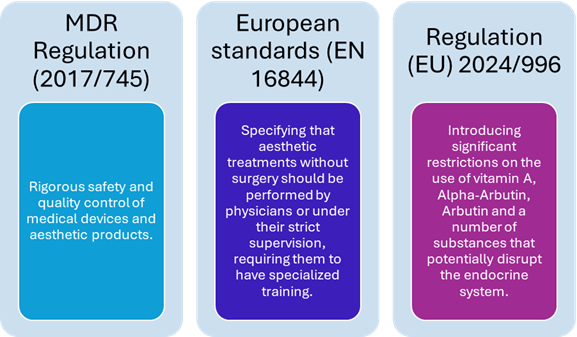
However, these are only selected EU regulations that impact the broader functioning of the beat industry. National law is essential to clarifying them.
The position of the Minister of Health regarding professional qualifications
Due to the growing popularity of aesthetic medicine treatments, the understatement of the regulation of the cosmetology profession, and social needs, on January 30, 2026, the Polish Minister of Health issued a communication regarding professional qualifications.
The Minister of Health’s announcement clearly states that aesthetic and restorative medicine procedures constitute healthcare services with a higher risk of complications and may only be performed by physicians and dentists with an indefinite license to practice their profession and appropriate certificates confirming completion of specialized training. These procedures have been a component of specialized programs for years, including in dermatology, venereology, and plastic surgery, and have been formalized as certified professional skills for physicians under applicable law.
The Ministry emphasizes that performing aesthetic and restorative medical procedures requires a complete diagnosis and exclusion of contraindications. Therefore, individuals without medical qualifications, including cosmetologists, aestheticians, and other non-medical professionals, are not authorized to perform these procedures, even if they have completed training and obtained certifications.
The announcement also indicates that certification of physicians in aesthetic and restorative medicine is based on a minimum standard approved by the Minister of Health, covering, among other things, injection procedures, the use of botulinum toxin, fillers, medical lasers, medical peels, and restorative procedures. These procedures must be performed only by registered medical entities.
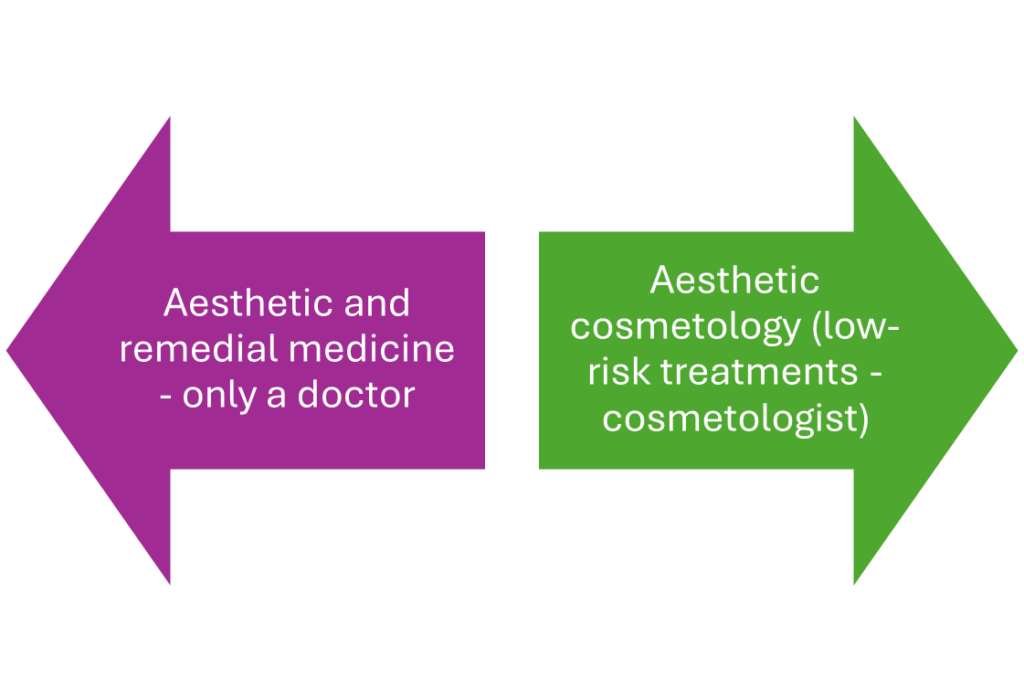
The aim of the adopted regulations is to ensure maximum patient safety by clearly separating medical procedures from aesthetic cosmetology treatments with a low risk of complications and assigning full responsibility for the entire treatment process to the physician as a person with appropriate qualifications and authorizations.
The scope of powers of individual professional groups
The scope of authority of individual professional groups in the field of aesthetic services is determined primarily by the nature of the procedures performed, their degree of invasiveness, and the risk to the patient’s health. Physicians and dentists are authorized to provide healthcare services, including aesthetic and restorative medicine procedures, which involve interference with tissue integrity, the need for medical qualification of the patient, diagnosis, and treatment of potential complications. Despite the lack of comprehensive statutory regulation of the profession, cosmetologists are authorized to perform aesthetic, beauty, and preventive cosmetology procedures, provided these procedures do not meet the definition of a healthcare service and are not related to the diagnosis or treatment of diseases. Beauticians, on the other hand, perform non-invasive beauty treatments in accordance with their professional qualifications. Therefore, the boundaries of authority of individual professional groups are not solely determined by the procedure names, but by their actual medical nature, therapeutic purpose, and potential health risks, which is crucial for the safety of individuals using aesthetic services.
Therefore, the qualifications of a cosmetologist include performing treatments such as:
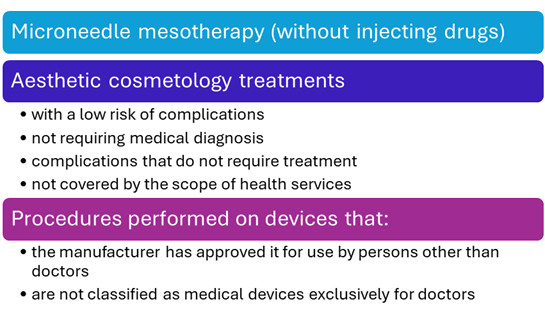
In practice, this means that a cosmetologist is competent to perform mainly facial and body care treatments, and to use devices whose manufacturer allows them to be used by cosmetologists.
According to the regulation, the distinction between:
Foreign solutions
The growing popularity of aesthetic medicine treatments, globalization and the development of tourism have contributed to the growth in popularity of medical tourism (even aesthetic medicine tourism offices specializing in mediation between the patient and the country where the procedure is performed have gained popularity), therefore foreign solutions regarding the regulation of the profession of cosmetologist, their competences, and that of a doctor or dentist and foreign legal solutions are arousing interest; here are some of them.
Beyond the western border, the situation proves equally rigorous. The Bundesärzteordnung (loosely translated, the Medical Code) is crucial. The related term, Arztovorbehalt (medical prerogative), means that, due to legal regulations, it can only be performed by a properly trained physician. According to these and other regulations in force in Germany and the EU, medical procedures reserved exclusively for physicians, which could once be performed by beauticians or cosmetologists, include:
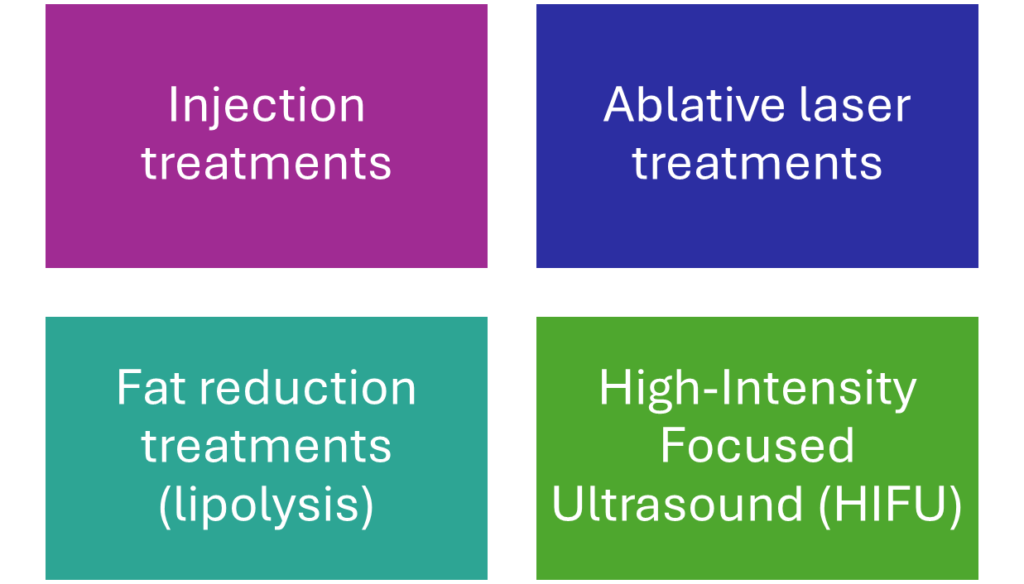
The situation is similar in France, where popular filler or botulinum toxin treatments cannot be performed by people without medical qualifications, according to the position Société Française de Médecine Morphologique et Anti-Âge (SOFMMAA) and Société Française de Médecine Esthétique (SFME) – the use of Botox remains a treatment that requires a trained and experienced doctor to avoid negative effects.
Discussions
The regulation of the cosmetology profession, which was not addressed in the Minister’s announcement, remains controversial. The recognition of selected aesthetic treatments as health services within the meaning of the Medical Activity Act remains controversial, as they are intended to “improve health,” also understood as improving mental and social well-being. The broad interpretation, blurring the boundaries of these activities, is controversial. This issue also appears problematic for cosmetologists who have been performing treatments using the preparations listed in the Minister of Health’s announcement for years, and who base their professional careers, certifications, courses, and training on this type of work.
Forecasts and demands de lege ferenda
The dynamic growth of the aesthetic and restorative medicine market has fueled the need to formalize and legalize this industry. The announcement from the Minister of Health sends a clear signal aimed at resolving professional competencies and strengthening patient protection as a healthcare provider. It can be assumed that the next step will be to clarify professional regulations governing the cosmetology profession and its competencies.
From a de lege ferenda perspective, the following steps seem reasonable

Conclusions
It seems justified to emphasize that aesthetic medicine, as a health service, has been clearly included within the scope of medical practice and reserved for physicians. At the same time, the widespread and constantly evolving field of aesthetic cosmetology points to the need for legal regulation of the cosmetology profession. Balancing two values seems crucial: the freedom to practice the profession and the development of the services market, as well as the overarching principle of protecting the patient’s life and health.
