Can an online auctioneer charge the maximum amount set by a bidder if the amount of the item being bid is less than the last bid?
Publication date: March 11, 2026
Regulation of concluding a sales contract by auction according to the Civil Code
Pursuant to Article 701 of the Polish Civil Code, a contract – including a sales contract – may be concluded through an auction or a tender. These two distinct contract-formation methods are distinguished by their specific characteristics, which include the multilateral and eliminatory nature of the procedure. Both procedures allow for the conclusion of a contract with the participant offering the most favorable terms from among many potential contractors, on equal terms and in compliance with the principles of free competition.
An auction is a process of concluding a contract through bidding, with participants submitting increasingly favorable offers throughout the auction. The process consists of three stages and includes:
- auction announcement,
- submitting offers (in the form of an auction),
- selection of the offer by confirmation.
Due to the relatively binding nature of regulations, organizers often tailor the auction or tender process to their own needs and the specific nature of their business. This is achieved by establishing detailed rules in terms and conditions or regulations, which often deviate from code regulations – this is particularly true for online auctions.
The auction announcement must specify the time, place, and subject of the auction, as well as specify its terms and conditions or the method of making them available to participants. In practice, this means that the detailed rules of a given auction are most often specified in the regulations, rather than directly in the provisions of the Civil Code.
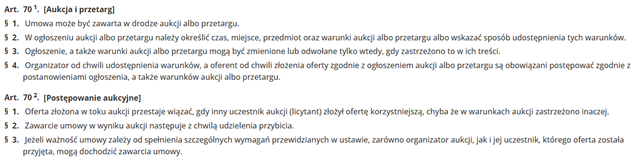
Pursuant to Article 70 § 2 of the Civil Code, an auction is conducted by submitting an offer to the organizer to conclude a contract, the content of which is determined by the provisions of the announcement, the auction terms, and the organizer’s own price declaration. Submitting an offer creates a binding offer within the meaning of Article 66 § 2 of the Civil Code, meaning that the organizer may accept it, leading to the conclusion of a contract.
A bid submitted during an auction ceases to be binding if another participant offers more favorable terms, unless the rules provide otherwise. The contract is concluded upon the acceptance of the bid, which occurs after three calls for further bids, when no other participant submits a higher bid.
As can be seen, the provisions of the Civil Code do not regulate the issue of establishing limits when concluding a contract through an auction procedure, and the commentaries to the provisions in question also do not contain any mention of this topic. In practice, the issue of setting limits will be regulated in the regulations and auction announcements and the conditions of specific auctions established there, and their provisions need to be analyzed.
The issue of setting limits on the ONE.BID website.
Referring to the regulations of the ONE.BID website, which allows auction houses to list their items and conduct online auctions, it is necessary to first explain several terms defined in the “glossary” of the regulations:
- Auction – a public sale of an Object organised by the Auction House in the form of an Auction, in which the buyer is the person who offers the highest price;
- Purchase Price – the final amount the buyer is obligated to pay for the Lot. This consists of the bid amount, the auction fee, and any additional fees specified by the Auction House;
- Starting Price – the amount at which the Bidding starts;
- Auction House – an entrepreneur cooperating with the Operator, usually engaged in trading in antiques, works of art or other collectibles, offering Objects for sale via the Website;
- Bidding – a procedure leading to the conclusion of a Sales Agreement initiated by the Auction House, in which the User declares the price at which they are willing to purchase the Auction Item. Bidding typically proceeds “upward” through Bidding. The User may submit subsequent Bids only if the current Bid and the sum of previous winning and winning Automatic Bids is less than or equal to the Spending Credit.
- Automatic Bidding – the process of automatic Bidding by the Website on behalf of the User, consisting in submitting subsequent Bids up to the amount indicated for a given Item by the User;
- Limit – an Automatic Bidding order for a given Object placed by the User and handled on his behalf by the Operator, up to the indicated amount;
- Object – an item offered for sale by the Auction House via the Website or put up for Auction;
- Offer Automatic – the User’s order for Automatic Bidding of a given Lot before the start of the Auction or during the live bidding up to the amount indicated by the User;
- Operator – a limited liability company managing the ONE.BID Website;
- Bid Increase – submission of a bid by the User during the live Auction for a specified amount, which is the next permissible increment of the current price of the auctioned Item;
- Bidding Increment – the amount by which the price of the Object changes during the Auction;
- Auction Regulations – the regulations of the Auction House specifying the rules for conducting and participating in the Auction, the conditions for concluding Sales Agreements and the delivery of purchased Objects;
- User – a natural person, legal person or organizational unit without legal personality who reads the content presented on the Website or uses the services offered on the Website under the terms set out in the Regulations and applicable legal provisions;
These definitions are essential to understanding the specific regulations governing auctions conducted on ONE.BID. Importantly, the site’s terms and conditions must be followed in all auctions conducted using the site.
Items offered in the Auction are offered for sale by the Auction House. The Operator is not a party to these Auctions; it merely provides the technical means to enable Users to participate in the Auction and Bidding in real time via the Internet, together with other people gathered in the Auction House’s auction room. (§ 11. Point 2) Participation in the Auction is conditioned upon registration via the Website and acceptance of the Auction Rules. The Auction Rules are available on the registration form for each Auction.
Bidding begins at the Starting Price. The Auctioneer may enter subsequent bid increments according to the Auction House’s bidding table. Depending on the course of the Auction, the Auctioneer may, in accordance with the Auction Rules, decide on a different bid increment at his or her discretion (§ 11. Point 5).
Establishing a limit is covered by § 12, point 5, according to which a User who cannot personally participate in the Auction may – if permitted by the Auction Rules – place bidding orders with a Limit. At this point, an analysis should be conducted and the relationship between the concepts of “Limit,” “Automatic Bidding,” and “Automatic Bid.”
“Automatic Bidding” refers to an automated process in which the IT system participates in the auction on behalf of the bidder and submits successive bids up to the amount specified for a given item. This limit is the set limit, which constitutes the Automatic Bidding order. A bidder’s order to conduct the Automatic Bidding system up to the amount specified in the limit is called an “Automatic Bid.” It’s important to note that during the Automatic Bidding process, the system submits successive bids —this means that the system “outbids” other Auction participants’ bids according to the increment table specified by the organizer, until the limit is exceeded.
It’s also worth paying attention to the information found in the “Help Center” tab on the ONE.BID website. This section explains the terms and conditions in an accessible way for the website user, and they cannot be inconsistent with the terms and conditions. When asked, “What’s the difference between a limit and an offer?” the website answers that: With both a limit and a bid (Bid Now), the machine won’t immediately use the maximum bid you specify. It will bid on your behalf to win at the lowest possible price, and you’ll pay that amount if you win.
Similar regulations can be found in the regulations of other websites and auction houses – an example is the regulations of the Sopot Auction House created for the purposes of the “Varia Auction” of July 3, 2021. The following fragments of Part III (2) (A) of the regulations will be of significant importance:
- “For the convenience of Bidders unable to attend the Auction in person, the Auction House will process written limit bidding orders and telephone bidding orders. In such cases, Bidders who are absent should complete a “bidding order” form, which can be found in the Catalog, on the Auction House website, or obtained in the Auction House galleries.”
- If a Bidder decides to place a limit bid, he or she indicates the items to be bid on his or her behalf along with the maximum bid amount.
- The Auction House will make every effort to ensure that the Bidder purchases the selected Item at the lowest possible price, but not lower than the Guarantee Price (the minimum price for which the auctioned Item can be sold).
- After registering for the Online Auction, the Bidder may also leave a limit bidding order without having to complete a written “bidding order” form.
Considering the above regulations, it should be stated that a limit represents the maximum amount a bidder is willing to spend on a given item. In the case of online auctions on ONE.BID, the system makes subsequent bids until the limit is reached or the most advantageous offer is reached. However, does this mean that if a bidder who has set a limit bids higher, the organizer has the right to consider this as an increment of the maximum established limit?
Analysis of the auction of Władysław Reymont’s historical novel “The Year 1794. Insurrection.” [first edition 1918 with autograph and dedication].

The auction in question featured the first edition of Władysław Reymont’s novel “1794. Insurrection.” The auction took place on October 19, 2025. The starting price was PLN 2,200. One auction participant agreed with the organizer that his bid limit was PLN 4,800. After the auction began, a bid was raised to PLN 2,400 – according to the increment table, in the PLN 2,000-5,000 range, increments of PLN 200. The bidder with the established limit then placed another bid, and a knockdown occurred. According to the increment table, the bid amount should have been PLN 2,600, but the auction ended at PLN 4,800 (the limit set by the winning bidder).
Pursuant to the aforementioned § 12, point 5 of the ONE.BID website regulations, the Auctioneer may enter subsequent Bid Increments according to the Auction House’s increment table. Depending on the course of the Auction, the Auctioneer may, in accordance with the Auction Regulations, decide on a different increment at their own discretion.
The Auction Rules do not include a provision allowing the Auctioneer to place bids at a different rate than specified in the Bid Increments Table. The Rules, in Section 5, allow bidders to place bid limits – however, this applies to written orders. If a bidder wishes to set a limit for a given item in an Auction they are participating in via the ONE.BID service, they must complete a dedicated field next to the item.
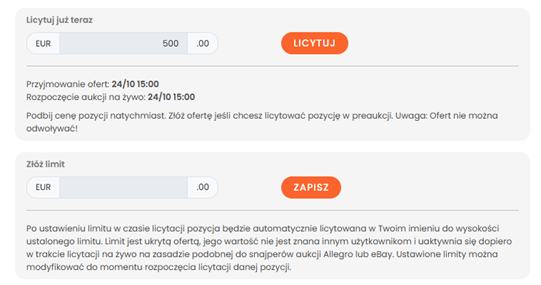
This is where the concept of automatic bidding comes in, which, as we know from the analysis of the regulations, means that the system will automatically place subsequent raises (in the amount specified in the increment table) until a certain limit is reached.
In such a case, if the next Raise is made by a person with an established limit, it shall be analysed if the organizer has the right to consider his statement as an offer made at the maximum limit amount. The following rules should be taken into account:
– The Organizer has not reserved in the Auction Rules the possibility of making bid increments at a different amount than specified in the table of increments.
– The Auction Rules do not contain a provision according to which a person who has set a limit by making a raise is deemed to have placed a bid at the maximum limit.
The establishment of a limit in an online auction is a declaration of will within the meaning of Article 60 of the Civil Code and is subject to interpretation in the light of Article 65 § 1 of the Civil Code. According to this provision, a declaration of will should be interpreted in a way that is required by the circumstances. The circumstances in which it was submitted, the principles of social coexistence, and established customs. Considering the circumstances of online auctions and the fact that users accept the ONE.BID website’s regulations, which provide clear rules for establishing limits, it should be concluded that this declaration of intent should be interpreted taking into account the provisions of the regulations in question – by submitting a declaration of intent to establish a limit, the user intends to produce the legal consequences that result from it. Therefore, any other interpretation of this specific declaration of intent would be inconsistent with the fundamental principles of the Civil Code. Established customs among shareholders indicate the significance of the “limit” institution and the legal consequences it produces (as evidenced by a similar regulation on this matter in the regulations of the Sopot Auction House).
