Publication date: February 6, 2026
Some hard numbers reveal the paradox: the EU has a highly developed research sector vs. the EU is a region with a challenging commercialization environment compared to other global leaders.
Biotechnology is one of the fastest-growing research and innovation sectors in the world today, and the European Union plays a significant role in this process. Over the past decade, the number of biotechnology researchers in the EU has nearly doubled, from approximately 42,000 in 2012 to over 81,000 in 2021, and the share of employment in this field has reached 17.2% of total R&D employment. These figures confirm that Europe has a strong scientific base and is systematically building capacity in technologies critical to health, industry, and food security.
More
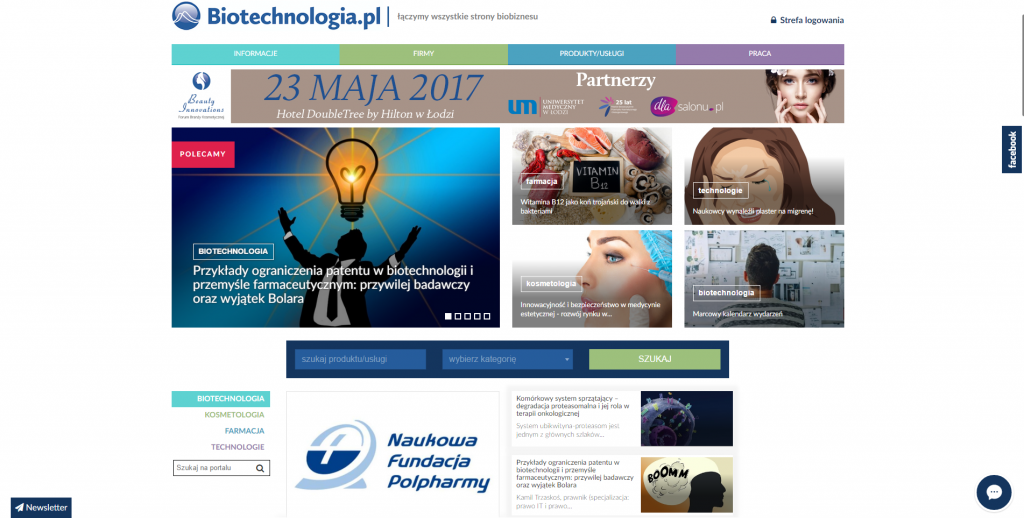
Biotechnologia.pl, which is the main polish media in biotechnology sector, recommends KG Legal’s article on its homepage.
More
 The article was prepared by KG LEGAL KIEŁTYKA GŁADKOWSKI based in Cracow, Poland, specialising in cross border cases, with its focus on new technologies, IT and life science, discusses start-ups, differences between business secret and know-how and the value of these for a company being a start-up, protection of intellectual property, the importance of patent law for start-ups, protection of biotechnological inventions, copyright, the patentability of inventions, protection of IT solutions, procedures for obtaining a patent and rights granted under a patent.
See the link to the article in Polish: http://mojafirma.infor.pl/prawo-autorskie/patent/749659,2,Polskie-startupy-w-IT-i-biotechnologii-ochrona-prawna.html
The information was prepared by Kamil Trzaskoś of KG Legal Polish Law Firm. KG Legal provides specialised legal assistance to IT, Life Science as well as investment processes in Poland and organises networking between Polish and international companies and research centres.
See our specialisations
More
Operation of the Garage LifeScience
In the second part of the programme, dr. Piotr Warchoł (also co-founder of Complexity Garage) introduced operation of the Garage. There are three categories of membership:
– regular
– academic
– commercial
The regular membership will gather mostly people unrelated with univerisites, but related with the DIY culture, that would create Open Space projects. To use the Garage they will have to pay a small fee.
The academic membership is free and is designed for scientific circles, researchers, which, from various reasons will not be able to carry out research at the University and also for students participating in competitions.
More
