The Act amending the Act on the National Cybersecurity System aims to implement Directive (EU) 2022/2555 of the European Parliament and of the Council of 14 December 2022 (NIS Directive 2) and the partial application of Commission Delegated Regulation (EU) 2024/1366 of 11 March 2024 supplementing Regulation (EU) 2019/943 of the European Parliament and of the Council.
The amendment to the KSC Act significantly expands the scope of the regulations and introduces new obligations in the field of cybersecurity management. The changes include, among other things, the implementation of risk management systems and expanded incident reporting requirements. The new regulations also strengthen the powers of supervisory authorities and significantly increase the maximum amount of financial penalties. It also introduces liability for the management staff (manager) of an entity. In practice, this requires certain entities to take steps to comply with the new regulations.
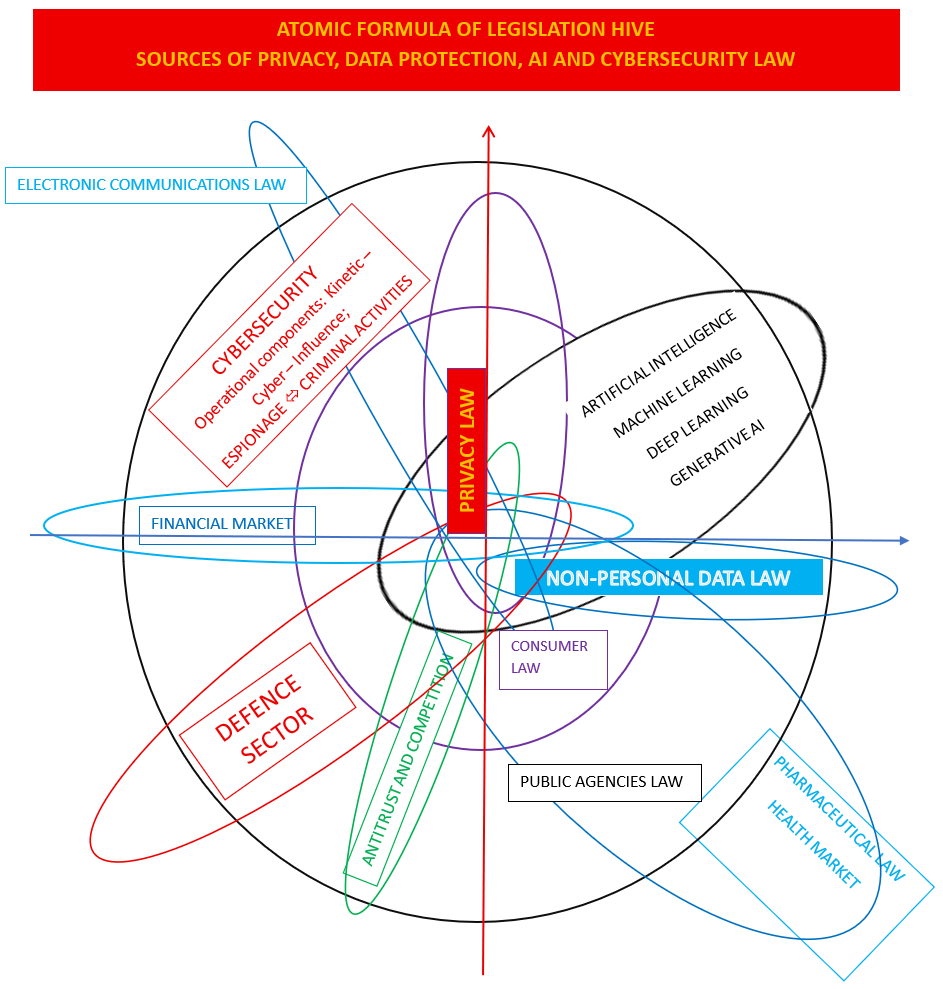
Data law is no longer just about GDPR. The European Union’s legislative trend of incorporating data law regulations into comprehensive sectoral regulations: healthcare, financial markets, corporate stock market law, the defense industry, electronic communications, and the phenomenon of fair competition in trade, is resulting in a significant fragmentation of legal sources, the core subject of which is “DATA AND DATA PROTECTION
The interpenetration and interaction of the sources of law in the shape of an atom
Siri, Cortana, Google and other applications use human voice to do a variety of things, e.g. searching for information, sending emails, calling somebody. Voice-based technologies are increasingly applied in legal environment and legal services, for example in legal advice rendered online and in legal translations. At the same time, new applications of innovative technologies caused the necessity to define the approach to privacy issues anew. The cases of Edward Snowden and Julian Assange showed us how meaningful privacy and its protection is and made us realize the excessive amount of personal data processed and stored daily. This is why privacy and its protection will soon become one of the most important personal rights. The issue of voice protection comes to the fore in this context. Voice is, obviously, a personal right. What is more, voice is becoming a tool used by most applications both for mundane activities as well as more complex ones, like ROSS AI operating on IBM’s Watson, which can do legal research and is learning to understand law with every research conducted by it. What if it was possible for such applications as Watson to use the voice of a specific lawyer and, with the use of voice sample, produce speech of a different content, for example in the form of legal advice? Well, practically it is possible, since last November Adobe presented Adobe VoCo to the world, which (when having a voice sample) is able to read various content differing from the conent sampled. The present article will try to shed some light to the issue of the risk involved with voice cloning technology in legal environment and will analyse whether law can adequately protect human voice as a personal right.